Welcome to all new Plotholders – we hope that you will be very happy here .
Starting Your Allotment Adventure:
- Choice of tools
To work your plot, as a minimum, you should have a garden fork or similar tool to allow you to dig the soil. This is necessary for preparing the ground for new plants, removing weeds and ultimately harvesting your crops.
Ensure that, whichever tool you choose for this job, it is the right size and weight for you!
Beyond a fork or similar, the following is a list of a typical set of tools that are likely to make it easier to maintain your plot:
A spade – stainless steel if you can afford it and want to minimise cleaning.
A hoe for keeping annual weeds down between your plants.
A rake for working the soil into a good tilth for sowing seeds.
A trowel for planting young plants from pots and seed trays.
A line for planting in straight rows. (Make your own, two sticks and a length of string).
Netting to protect e.g. soft fruit from garden birds and cabbages from pigeons.
Canes of various lengths to support plants such as runner beans.
These tools are likely available at all garden centres (local options include: Millets Farm OX13 5HB and Notcutts Oxford OX44 9PY. There may also be a small selection of tools and garden equipment in Abingdon town at Lewis Baker on Bridge Street OX14 3HN)
Other Wildmoor members may also have spare tools (and indeed spare seedlings in the spring) see our Facebook site for more information:
https://www.facebook.com/groups/333592260698562/
- Preparing the soil
The time of year you obtain the allotment will influence your decision.
Thoroughly prepare manageable sections at a time. So that you can plant and get some early rewards.
Dig over to a depth of 9 – 12 inches using a fork. Break up the soil and remove perennial roots and underground stems. If the underground stems of Bindweed (relatively thick, white) and/or the underground stems of Horsetails (thin, black) and/or the underground stems of Couch Grass (white and relatively thin) are present you need to ensure that you remove these as completely as possible. If shoots of these appear later try spraying them with glyphosate (e.g. Roundup or Deep Root) as soon as they appear taking care not to spray your crop.
Dandelions and docks have deep taproots and you need dig these out or remnants left in will regenerate. None of the above perennial weeds should be put on your compost heap; they can be dried and burned or put in the vegetation re-cycling bin.
The rest of the plot can be covered with a light-proof material (but not old carpets) which, over a long period, should starve the weeds of light so that soil preparation becomes easier.
- Plants need nutrients.
Your plot may be impoverished in terms of plant nutrients so you will need to add some to produce rewarding crops.
Possible sources are:
- well rotted farmyard manure or horse manure (also improves texture of the soil)
- well rotted compost (also improves texture of the soil)
- Growmore balanced, general fertilizer
- Choice of first crops
For quick crops – salads such as radish, lettuce, Mizuna or Rocket.
For keeping weeds down – potatoes (especially early varieties for interest and taste).
For winter cropping – leeks, parsnips, sprouts and purple sprouting broccoli, kale, celeriac.
For summer treats – sweet corn, dwarf beans or runner beans.
Do not make permanent planting of currants, gooseberries, strawberries or asparagus until you are sure you have cleared the ground of perennial weed such as bind weed, horsetails or couch grass. (see above).
- Planting seeds or buying young plants
This is a balance between convenience and cost.
Starting seedlings in pots or trays for an early start avoiding frosts. You will need some good quality seed compost, pots or seed trays and a frost-free place to keep them while they germinate. Follow the instructions on the seed packet.!!! Once germinated, make sure the plantlets have sufficient light or they will become week and elongated. When large enough to handle, plant out on the allotment.
Most garden centres stock young plants at appropriate times of the year.
Monitor your crops regularly and make sure you harvest them when they are at their best
- How organic do you want to be?
There is little need to use insecticides if you keep a close eye on your crops. Watch out for black fly on broad or runner beans and, if present, gently squash them. If you find caterpillars on your cabbage, sprouts or purple sprouting, pick them off and dispose of them. You will need to protect seedlings such as lettuce from slugs and snails.
You will probably need to net some crops against white butterflies, deer, pigeons etc. Ask your plot neighbours.
There is a range of organic fertilisers available in garden centres.
- Size guide
Prospective allotment holders are often surprised by the size of the plots when they visit the site. The images below are intended to give an impression of our typical full and half-sized plots. A small number of approximately 1/4 sized plots may also be available.
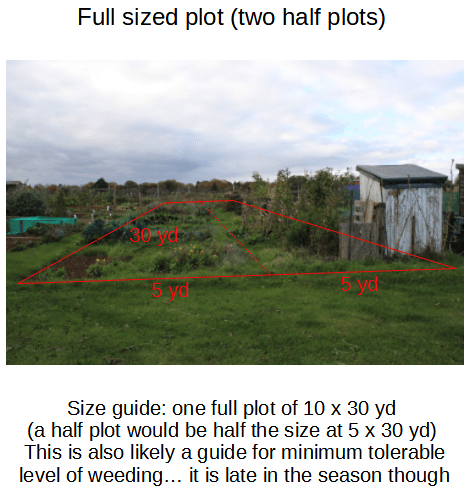

- Sources of information and advice
Dennis Sutton (Allotment & Leisure Gardener Issue 1 2016)
Advice from one of our members who started a little over a year ago –
See also – https://www.allaboutallotments.co.uk/allotments-for-beginners
 Wildmoor Allotments